


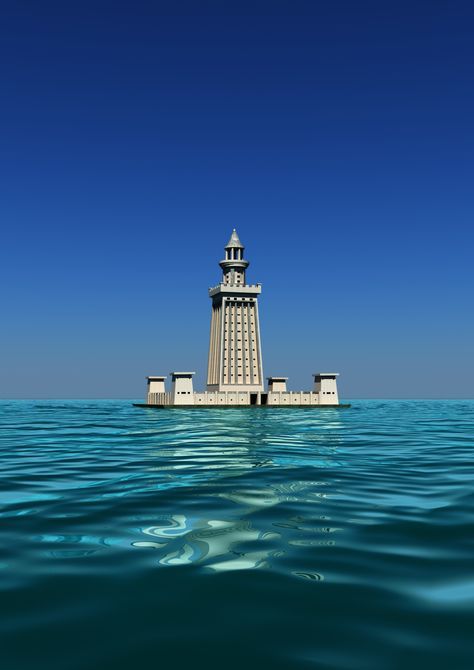
In the annals of ancient history, few structures evoke as much awe and wonder as the Lighthouse of Alexandria, one of the Seven Wonders of the Ancient World. Rising majestically from the shores of the Mediterranean, this beacon of light not only guided sailors safely to harbor but also symbolized the ingenuity and grandeur of the Hellenistic world. Yet, beyond its physical magnificence lies a tapestry of history, hidden facts, and even connections to religious narratives such as the life of Jesus.
Unraveling the History:
Constructed around 280 BC during the reign of Ptolemy II Philadelphus, the Lighthouse of Alexandria stood as a testament to the flourishing intellectual and cultural exchange in ancient Alexandria, Egypt. Designed by the Greek architect Sostratus of Cnidus, its purpose was clear: to guide sailors safely through the treacherous waters of the Mediterranean, marking the entrance to the bustling port city.
The Hidden Facts:
Though much of the lighthouse’s structure has been lost to the ravages of time and natural disasters, historical accounts and archaeological findings provide glimpses into its engineering marvels. Standing over 100 meters tall, the lighthouse was adorned with intricate carvings and topped with a massive bronze statue, likely depicting either Zeus or Poseidon. Its inner core was constructed of limestone blocks, while its outer surface gleamed with white marble, reflecting the sun’s rays by day and the beacon’s light by night.
One of the most intriguing aspects of the lighthouse is its method of illumination. While the exact mechanisms remain a subject of debate among historians and archaeologists, it is widely believed that a system of mirrors and lenses focused the light from a fire at the pinnacle of the tower, amplifying its brightness and visibility for miles around.
Powering the Light:
The question of how the lighthouse was powered has long fascinated scholars. Some theories suggest that a furnace fueled by wood or oil provided the necessary heat to keep the fire burning bright, while others propose the use of a system of reflective mirrors to concentrate sunlight during the day.
The Spiritual Connection:
Intriguingly, some historians have drawn parallels between the Lighthouse of Alexandria and certain religious narratives, including the life of Jesus. While the connections are speculative, they offer a fascinating lens through which to view this ancient marvel.
One such connection revolves around the symbolism of light and guidance. Just as the lighthouse guided sailors safely through perilous waters, Jesus is often depicted as a guiding light for humanity, leading believers toward salvation and enlightenment.
Furthermore, the lighthouse’s location in Alexandria, a city known for its diverse cultural and religious influences, underscores the idea of universal illumination and the potential for spiritual enlightenment to transcend cultural boundaries.
Conclusion:
The Lighthouse of Alexandria stands not only as a testament to ancient engineering prowess but also as a symbol of human aspiration and ingenuity. From its towering height to its innovative methods of illumination, it continues to captivate the imagination and inspire awe in all who contemplate its mysteries. And perhaps, in its hidden depths, lie even deeper connections to the spiritual and cultural tapestry of humanity’s collective history.
The relativity between the Greek term “phoros” and the Egyptian term “pharaoh” lies in their linguistic roots and historical contexts. While they share similarities in sound and spelling, their meanings and origins differ significantly.
- Phoros (Φόρος):
- In ancient Greek, “phoros” referred to a tribute, tax, or burden imposed by a ruling authority on its subjects or conquered territories.
- This term is primarily associated with the fiscal systems of ancient Greek city-states and empires, where citizens were required to pay taxes or tributes to support the government or military endeavors.
- Pharaoh (𓂋𓈎𓏏𓊖 – Per-aa):
- The term “pharaoh” originated in ancient Egypt and referred to the title of the monarch or ruler of the Egyptian civilization.
- Translated as “Great House” or “High House,” “pharaoh” denoted the divine authority and supreme power wielded by the king over the land and its people.
- Pharaohs were revered as god-kings who embodied the divine will and were responsible for maintaining order, prosperity, and cosmic balance (ma’at) in Egyptian society.
Despite the linguistic resemblance, the concepts of “phoros” and “pharaoh” represent distinct aspects of governance and authority within their respective cultures.
Regarding the connection with the fall of the Second Temple in Jerusalem:
The fall of the Second Temple in Jerusalem in 70 CE was a pivotal event in Jewish history, marking the destruction of the holy sanctuary and the dispersal of the Jewish people. While there is no direct connection between the Greek concept of “phoros” or the Egyptian “pharaoh” and the fall of the Second Temple, historical and political factors played a significant role.
During the period leading up to the destruction of the Second Temple, Judea was under Roman occupation, and tensions between the Jewish population and Roman authorities were escalating. The Roman prefect at the time, Pontius Pilate, along with other Roman governors, imposed heavy taxes and oppressive policies on the Jewish population, contributing to widespread discontent and unrest.
Additionally, the political and religious divisions within Jewish society, particularly between different factions such as the Pharisees, Sadducees, and Zealots, further destabilized the region. Internal strife, coupled with external pressure from Roman forces, culminated in the siege and eventual destruction of Jerusalem and the Temple by the Roman legions under Titus.
While the terms “phoros” and “pharaoh” may not directly relate to the events surrounding the fall of the Second Temple, they highlight broader themes of authority, taxation, and governance that shaped the political landscape of the ancient world and influenced the course of history in the region.
“Finding Light Amidst Destruction: Lessons from the Lighthouse, Pharaohs, and the Fall of the Second Temple

 Bosses Made Men
Help us improve our community…………….. Tell us how we’re doing?